










How ShellKode Uses AWS Security Agent to Secure Software in the AI Era
Building secure software at AI speed with AWS Security Agent at the center of our application security approach.
Security Must Evolve at the Speed of AI
Artificial intelligence is changing how software is designed, developed, tested, and deployed. Engineering teams can build applications faster, automate complex workflows, and introduce new capabilities with unprecedented speed.
But faster development also introduces a fundamental challenge: how do we ensure that the software we build is secure before it reaches our customers?
At ShellKode, we believe security should be part of the engineering process from the very beginning. It should not be a final checklist performed immediately before a production release.
As we build cloud-native applications, AI-powered products, APIs, and enterprise solutions, our approach focuses on identifying vulnerabilities early, validating security controls, and reviewing applications before they are released.
To support this approach, AWS Security Agent is central to how we approach application security, complemented by specialized open-source tools that provide additional coverage across code, dependencies, infrastructure, and running applications.
Our objective is simple: build at AI speed without compromising on security.
Why AWS Security Agent?
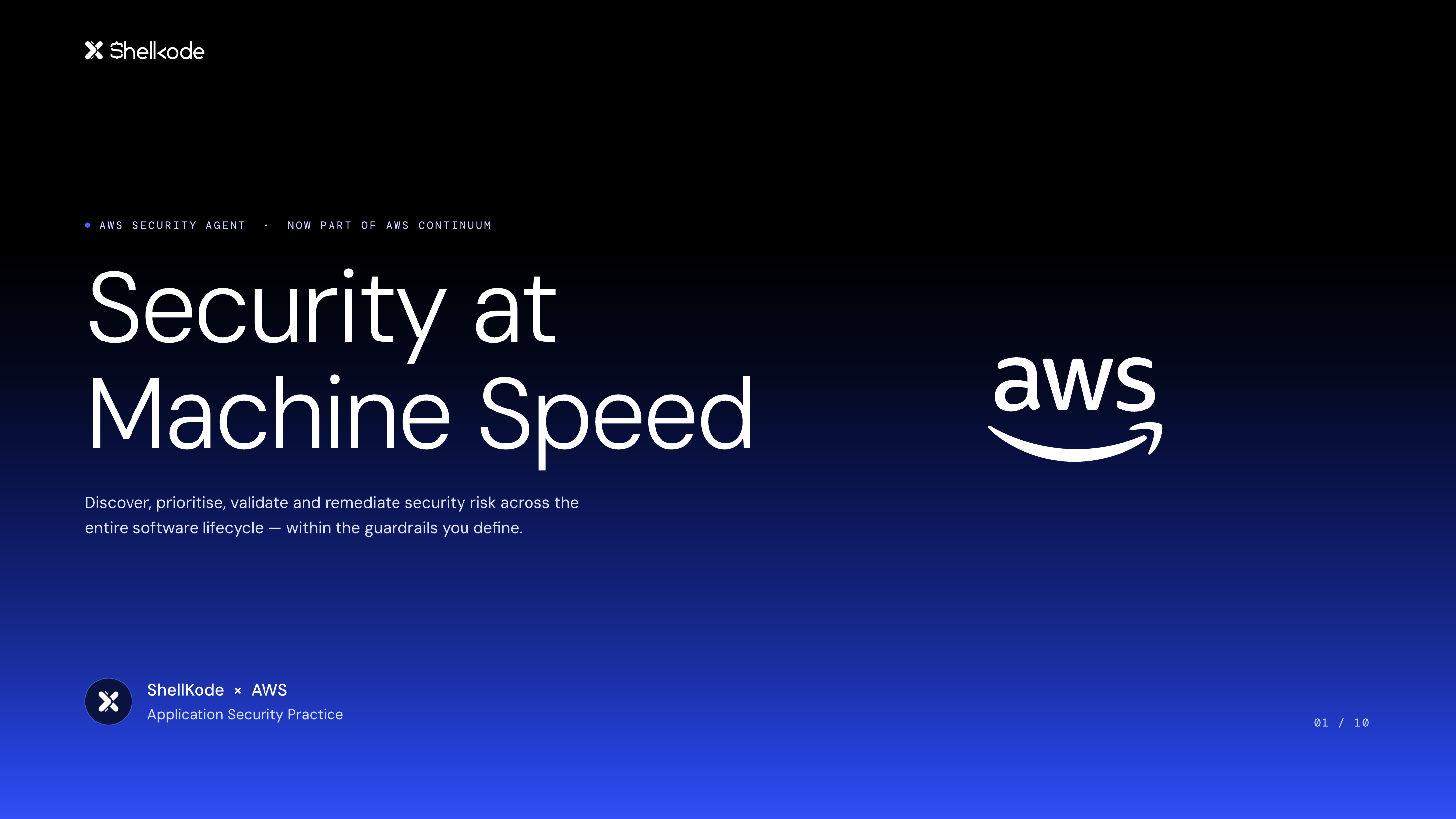
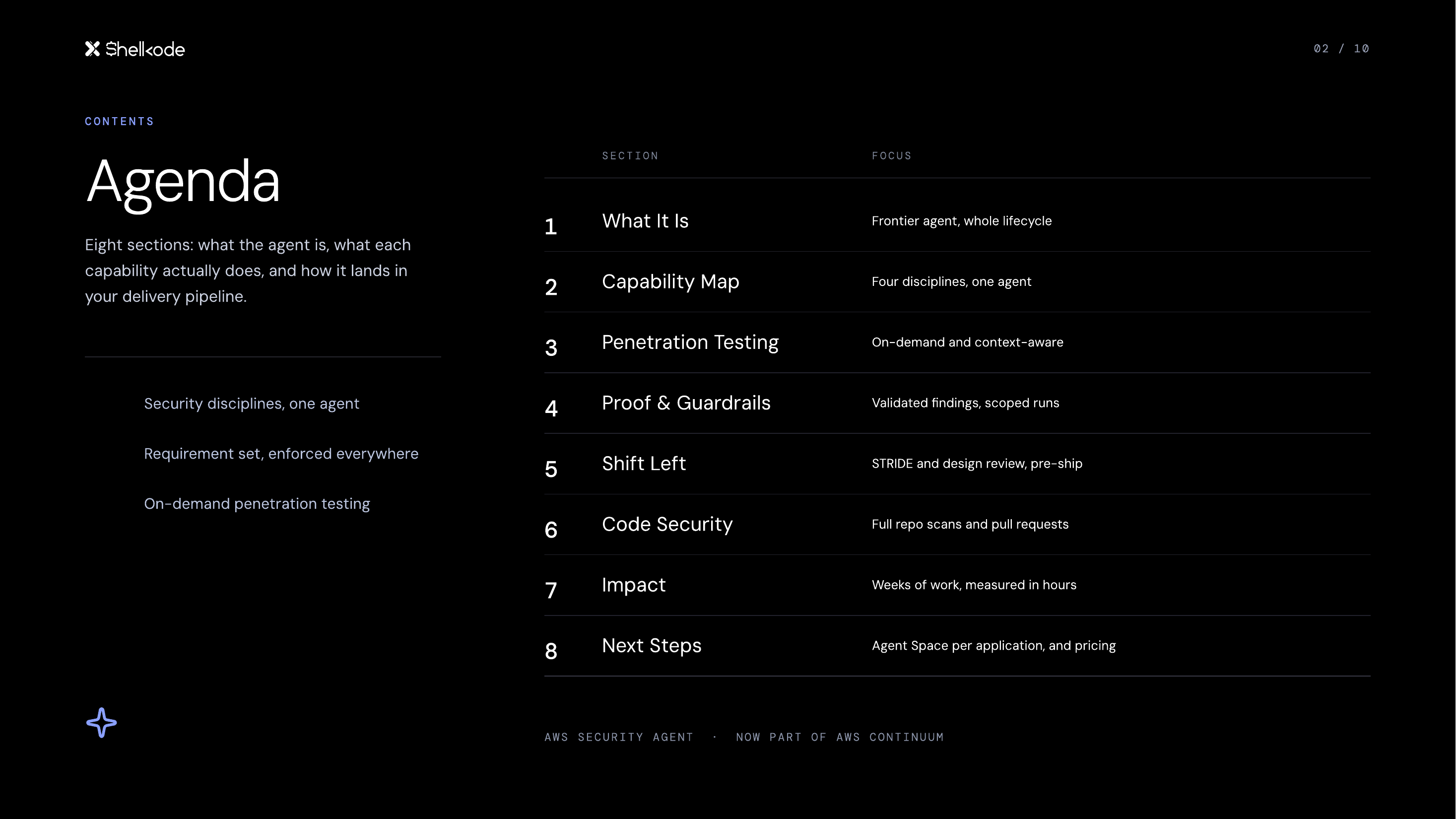
AWS Security Agent, now part of AWS Continuum, brings AI-powered application security capabilities across multiple stages of the software development lifecycle.
Rather than treating design reviews, code analysis, threat modeling, and penetration testing as entirely separate activities, AWS Security Agent helps teams investigate application security in context and evaluate applications against defined security requirements.
For ShellKode, this is particularly important because every application has its own architecture, data flows, authentication mechanisms, integrations, and potential attack paths.
A security approach that understands these relationships can provide more useful feedback than isolated checks alone.
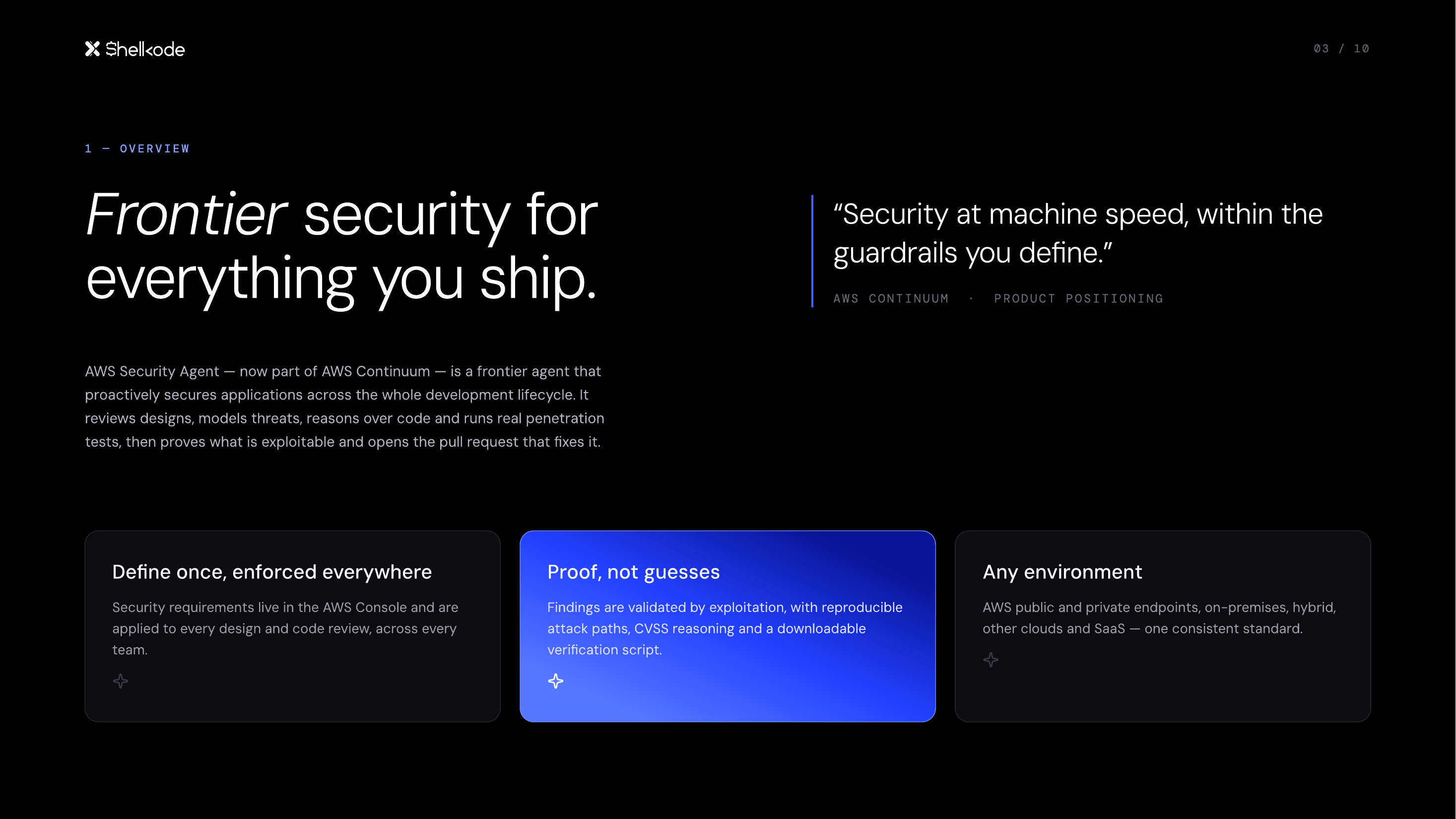
AWS Security Agent supports four important security activities.
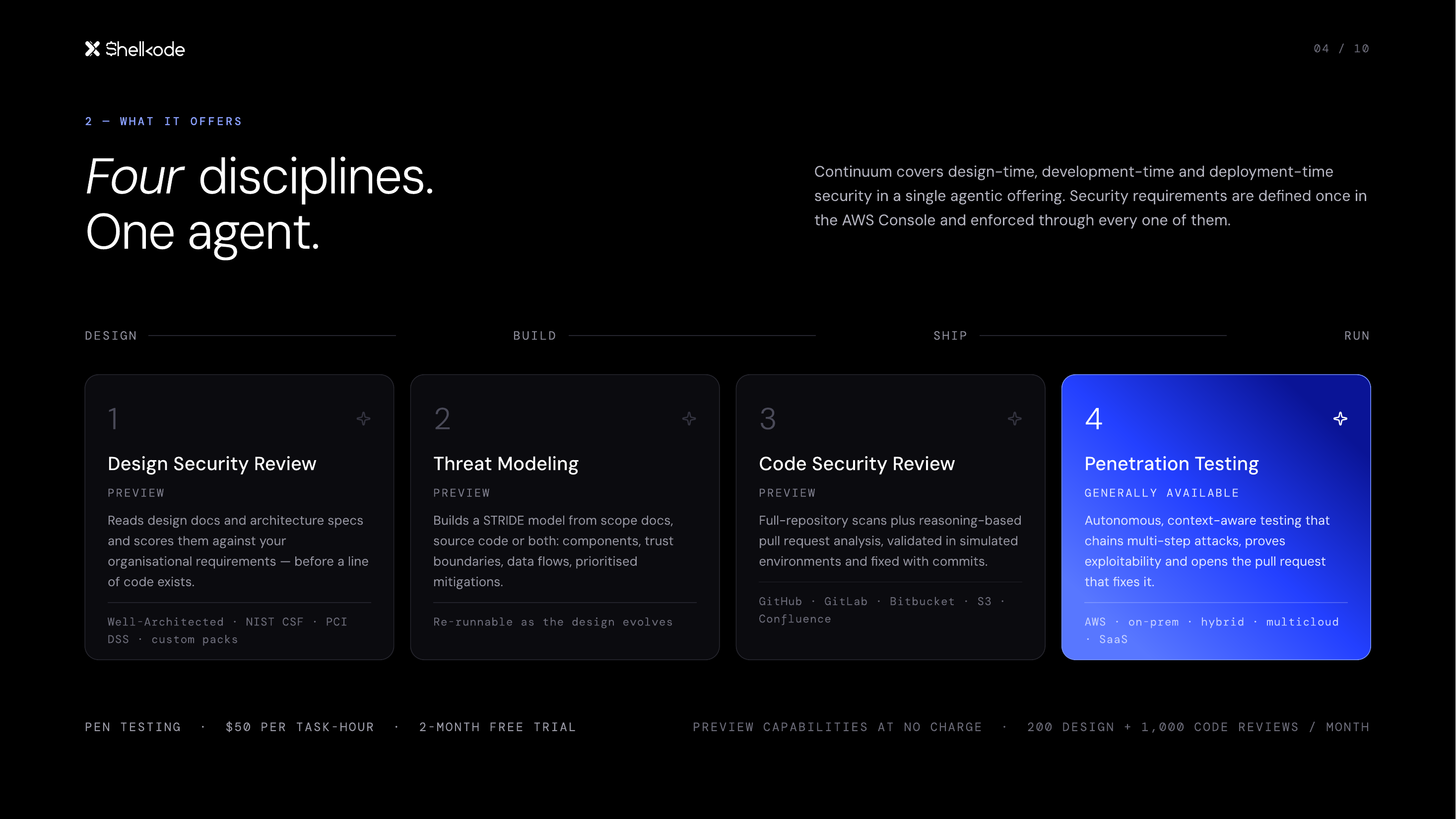
1. Threat Modeling Before Development
Security starts with understanding how an application could be attacked.
During threat modeling, AWS Security Agent can analyze application source code and design documentation to identify architectural components, trust boundaries, data flows, and potential threats.
This helps us evaluate questions such as:
- Can one user access another user's data?
- Are authentication and authorization enforced correctly?
- Could sensitive information be exposed through an API or third-party integration?
- Are privileged operations and external system connections appropriately protected?
Threat modeling helps teams identify security weaknesses before they become deeply embedded in an application's architecture.
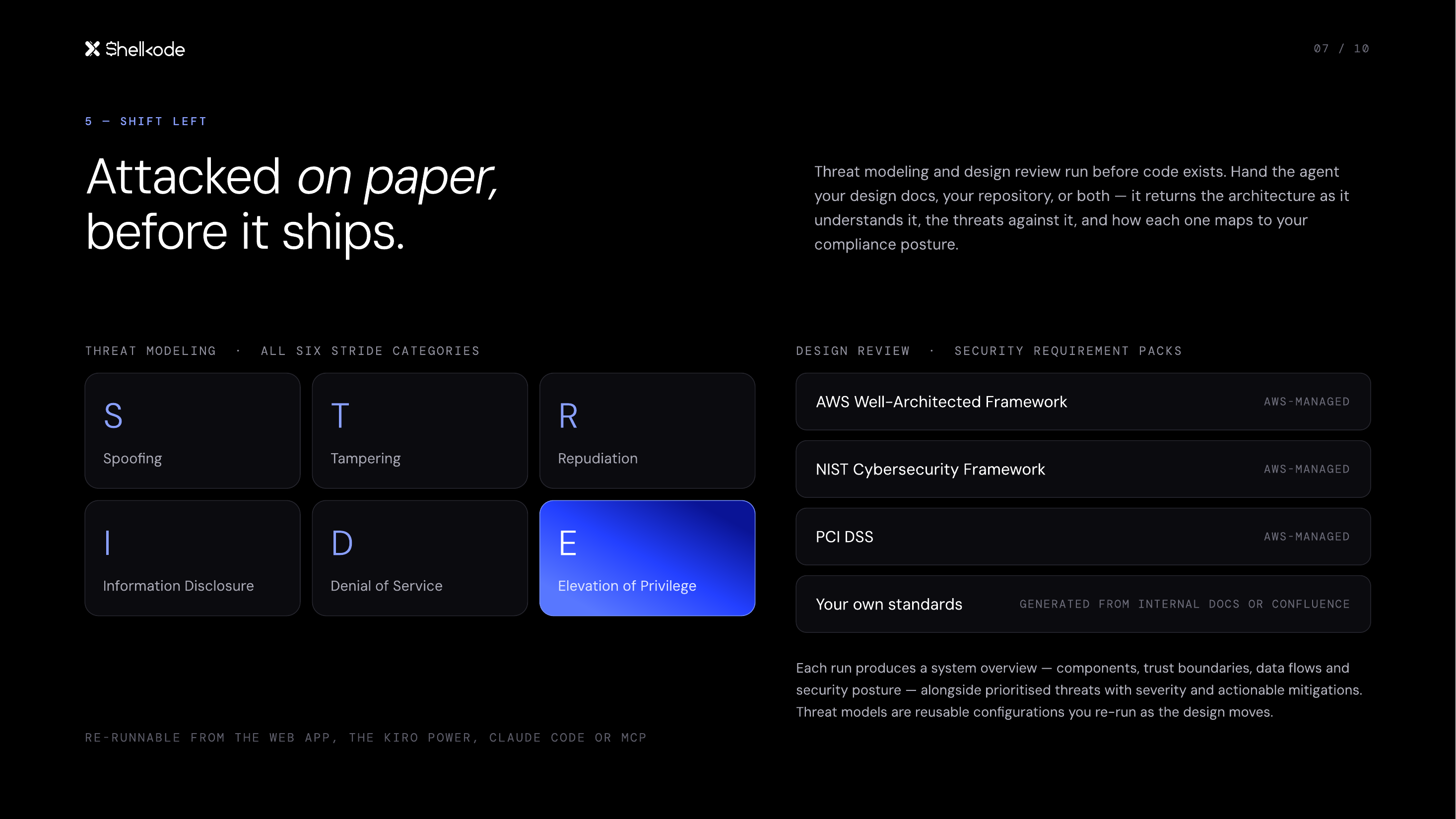
2. Code Security Reviews During Development
Writing code that works is only one part of building production-ready software. That code must also behave securely under unexpected and potentially malicious conditions.
AWS Security Agent can review application code for security vulnerabilities and assess it against organizational requirements.
Where supported, code-review findings can be integrated into GitHub pull-request workflows, providing actionable feedback closer to the point where code is developed.
At ShellKode, the goal is to make security part of everyday engineering rather than an activity reserved for the final stages of a project.
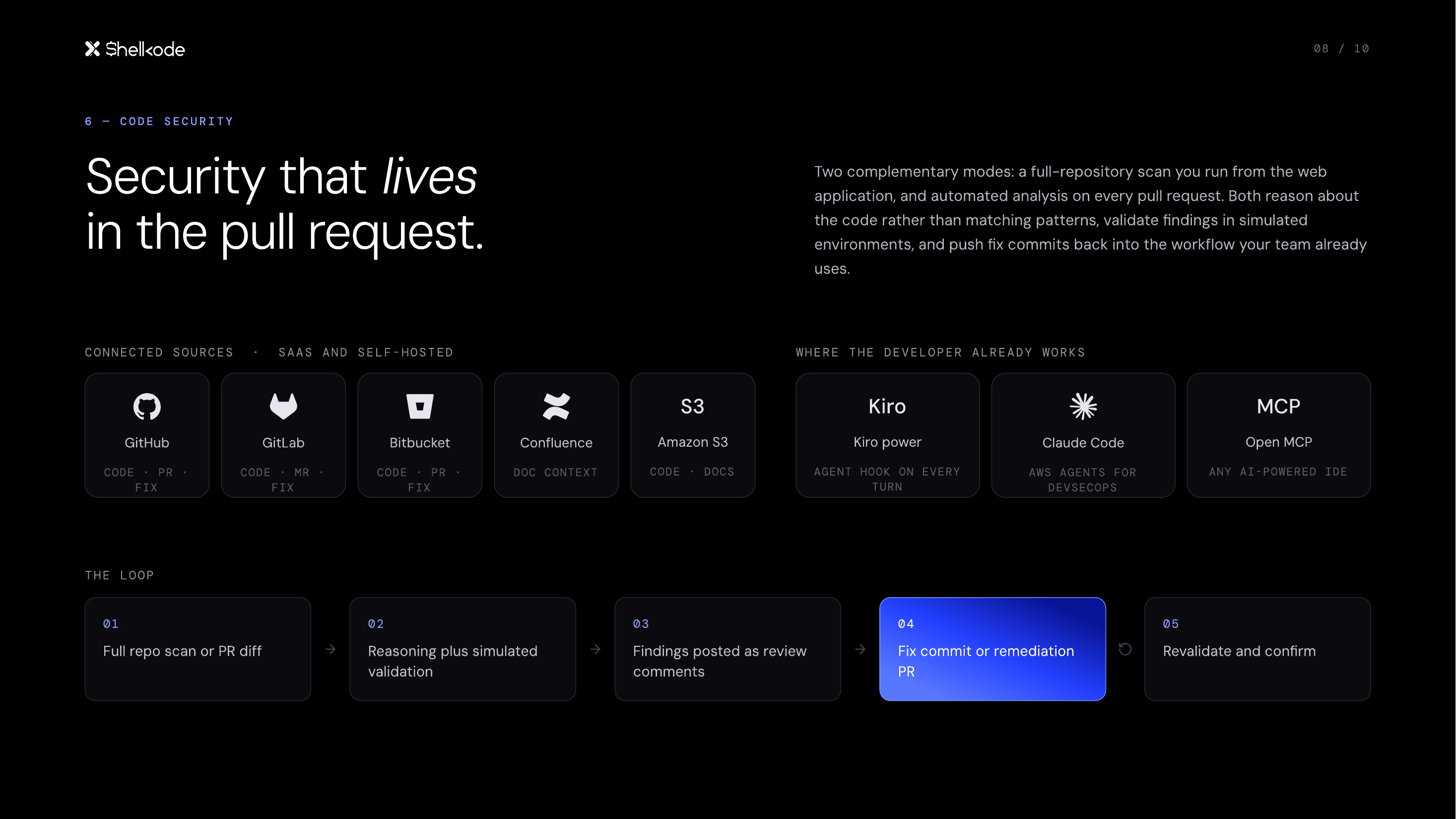
3. Design Security Reviews
Application security is influenced by decisions made long before deployment.
Architecture, identity management, network boundaries, data storage, external integrations, and access controls all influence the final security posture.
AWS Security Agent can evaluate design documents against defined security requirements and provide findings and remediation guidance.
Reviewing these decisions early helps engineering teams address security concerns before they become costly implementation changes.
4. On-Demand Penetration Testing
Automated scans can identify suspicious patterns, but understanding whether a vulnerability can actually be exploited requires deeper investigation.
AWS Security Agent supports on-demand penetration testing that investigates applications through multi-step attack scenarios, with findings that include impact analysis and reproducible attack paths.
This provides a way to validate potential weaknesses before a release, rather than relying exclusively on periodic security assessments.
Testing must always be performed within authorized application scopes and approved environments.
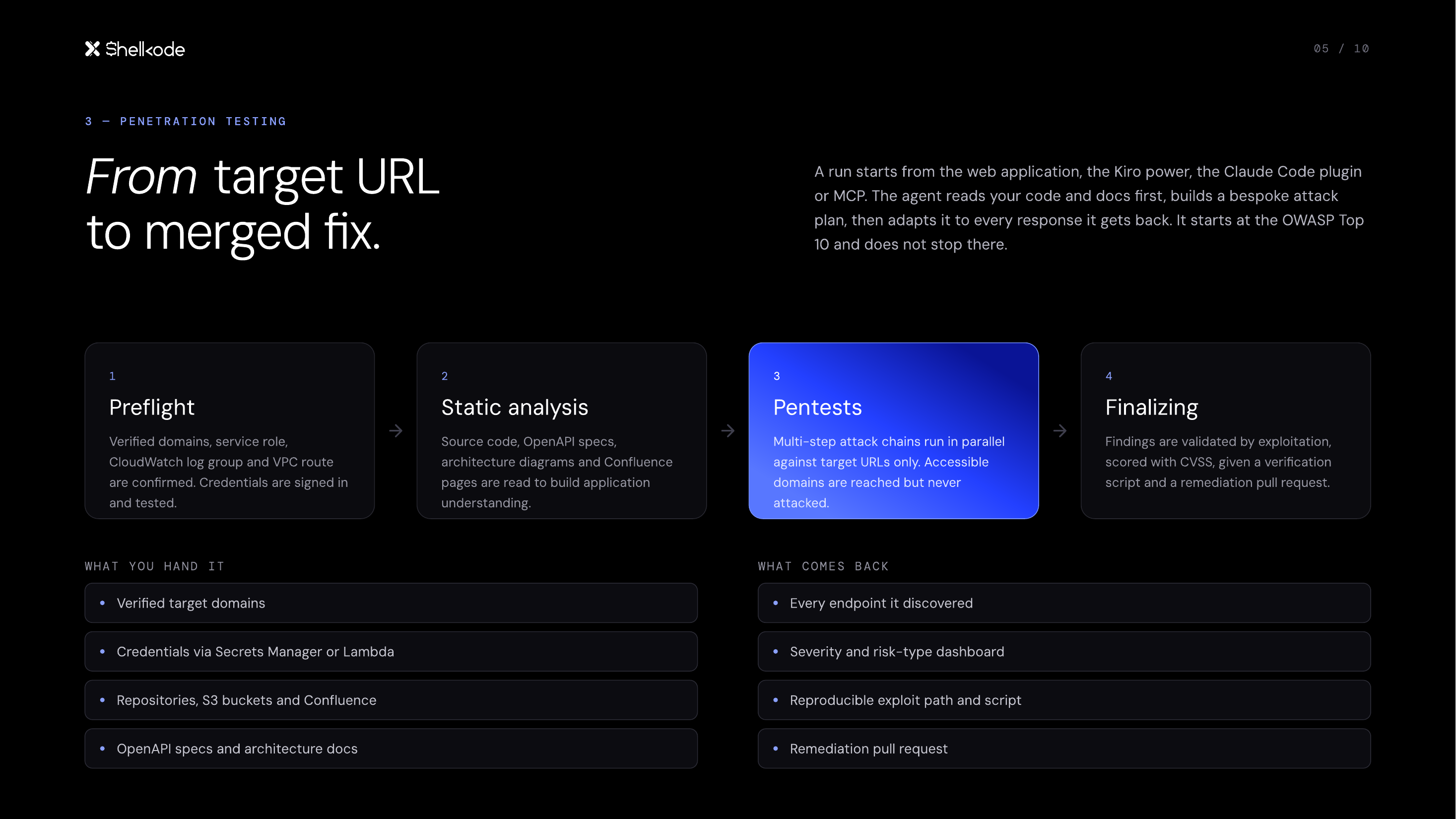
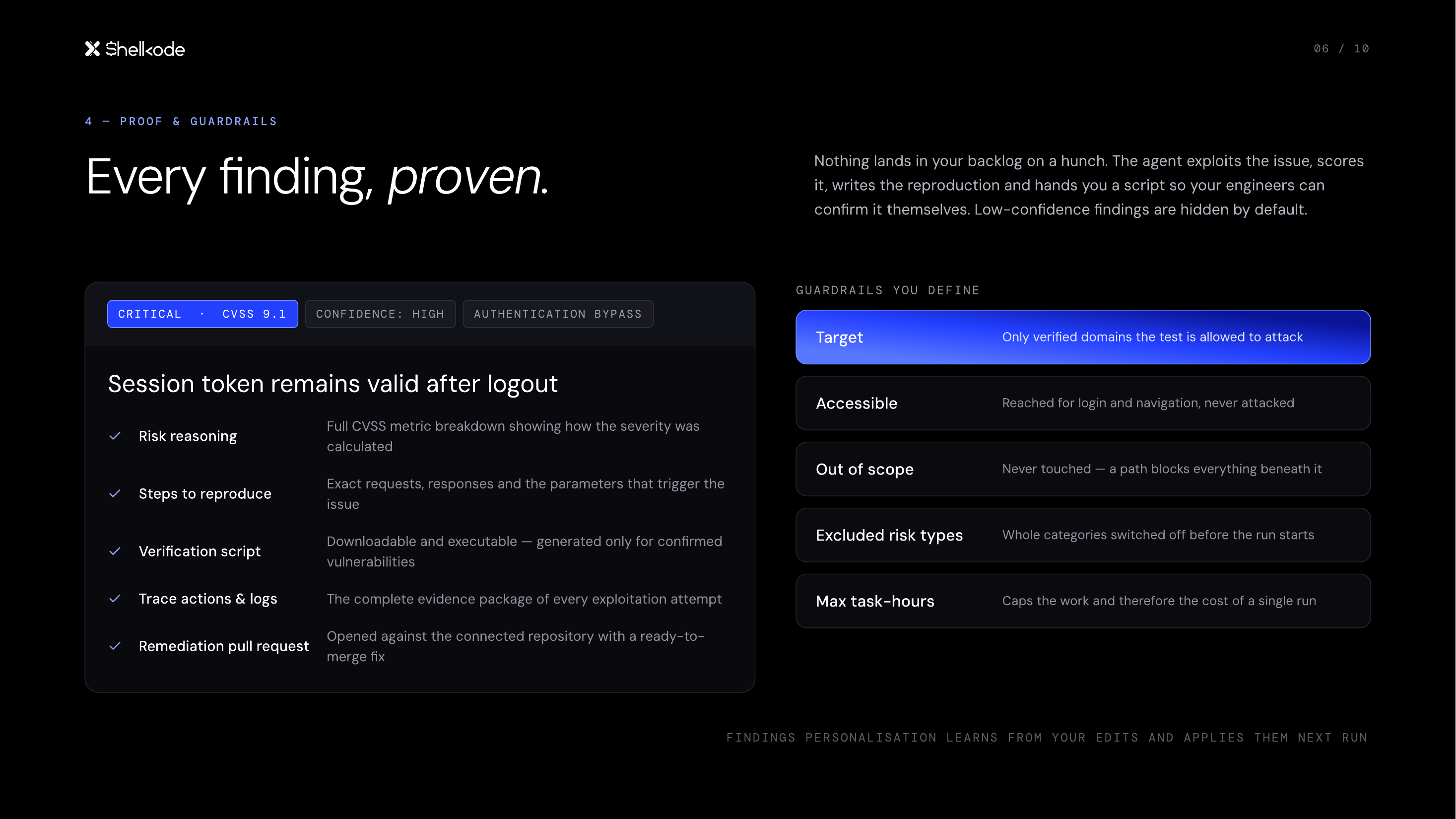
For ShellKode, the objective is to move beyond merely identifying potential vulnerabilities toward understanding their impact, validating the findings, and driving remediation.
Learn more: AWS Security Agent — Official Documentation
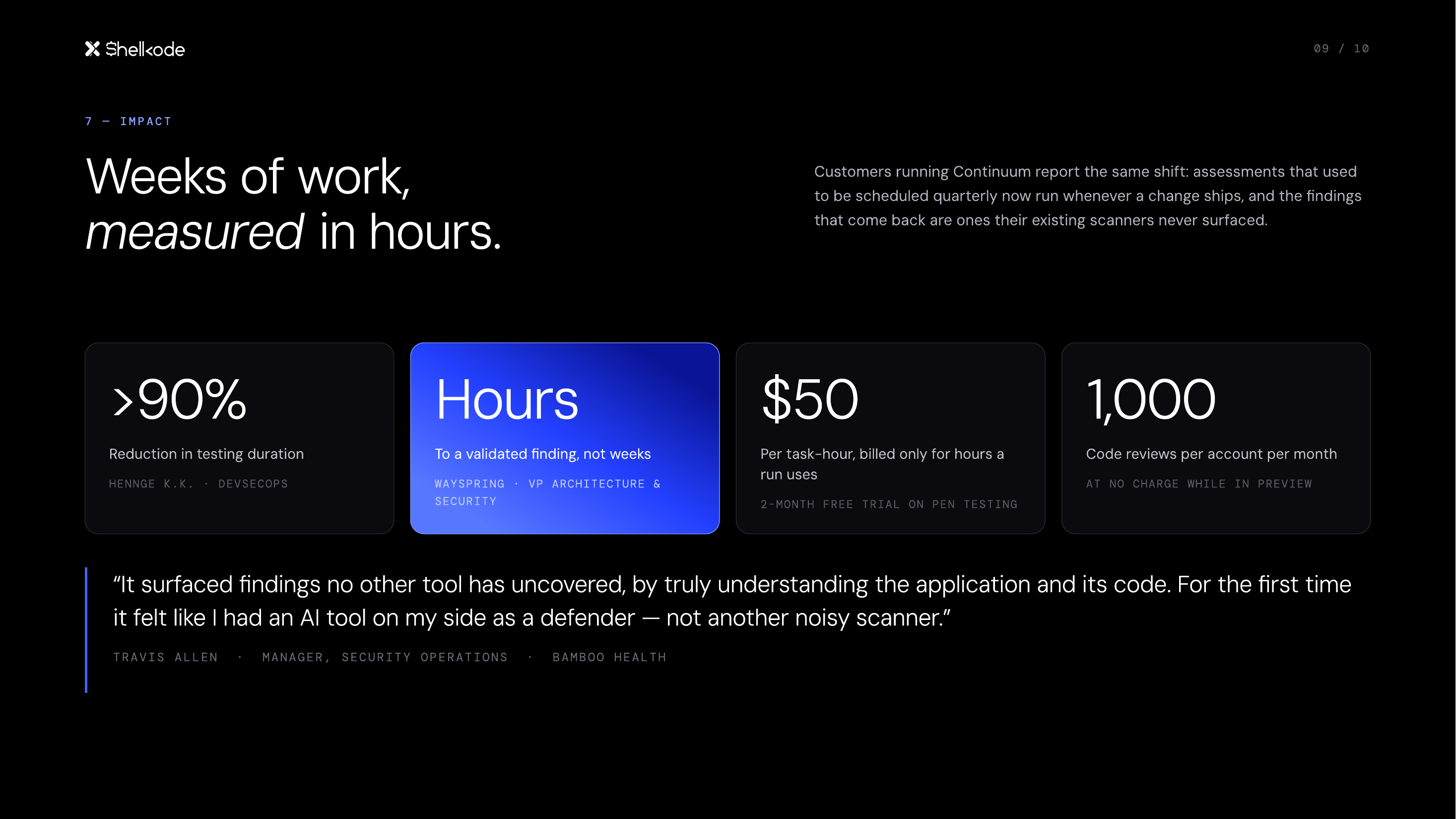
AWS Security Agent vs. Open-Source Security Tools
Application security requires multiple complementary techniques. No single tool should be assumed to detect every vulnerability across source code, cloud infrastructure, dependencies, and running applications.
We see AWS Security Agent as the central contextual application-security capability, with open-source tools providing additional specialized checks.
Strix: AI-Driven Penetration Testing
Strix is an open-source, AI-driven security-testing tool designed to investigate application vulnerabilities.
Its ability to execute customizable, agent-driven testing makes it a useful candidate for additional penetration-testing assessments.
For ShellKode, Strix can complement AWS Security Agent when we need an additional testing perspective, greater customization, or a self-hosted assessment workflow.
Semgrep: Static Code Analysis
Semgrep supports rule-based code analysis and security checks.
It can provide fast, repeatable feedback during development and help identify known insecure coding patterns before changes reach production.
Trivy: Vulnerability and Artifact Scanning
Trivy helps identify vulnerabilities and other security issues in dependencies, container images, repositories, secrets, and supported configuration files.
This is especially useful for containerized applications and cloud-native deployment pipelines.
Checkov: Infrastructure-as-Code Security
Checkov helps identify security misconfigurations in infrastructure-as-code.
This provides an additional layer of protection for deployment configurations and infrastructure definitions before they are applied to production environments.
Comparing the Roles
- Context-aware security reviews — AWS Security Agent: reviews application designs and code against security requirements.
- Threat modeling — AWS Security Agent: identifies architecture-level threats and recommends mitigations.
- Agent-driven penetration testing — AWS Security Agent and Strix: investigates and validates application vulnerabilities.
- Static code checks — Semgrep: detects insecure coding patterns.
- Dependency and container scanning — Trivy: identifies vulnerable components and artifact-level risks.
- Infrastructure-as-code checks — Checkov: finds insecure infrastructure configurations.
The tools serve different purposes. AWS Security Agent's advantage for our approach is the combination of contextual design and code reviews, threat modeling, and on-demand penetration testing, with organizational security requirements guiding supported reviews.
The open-source ecosystem remains valuable because it provides specialized checks, customization, and additional opportunities to validate application security independently.
Our philosophy is not to choose between AI-powered security and open-source security tools. It is to combine their strengths, with AWS Security Agent at the center of our application-security approach.
From Code to Production: Our Security-First Approach
Security must follow the application throughout its lifecycle.
At ShellKode, our intended production-readiness process brings together security assessment, automated checks, remediation, and review before software is released to clients.
- Design and threat modeling: evaluate architecture, trust boundaries, data flows, identity controls, and potential attack scenarios before implementation.
- Development and code review: review code changes and use appropriate static analysis, dependency checks, and infrastructure-security tools to identify vulnerabilities early.
- Pre-production security assessment: use AWS Security Agent for the required application-security reviews and authorized penetration testing. Add complementary tools such as Strix and OWASP ZAP where appropriate.
- Remediation and validation: investigate findings, resolve release-blocking vulnerabilities, and rerun relevant assessments to verify that fixes are effective.
- Production approval: review assessment results, outstanding risks, approved exceptions, and required sign-offs before authorizing the release.
- Continuous reassessment: revisit application security when significant changes, newly discovered vulnerabilities, or the application's risk profile warrant additional testing.
A clean scan does not guarantee that an application is completely secure. Our approach therefore relies on multiple assessment techniques and appropriate engineering oversight.
Building Trust Through Security
At ShellKode, innovation and security must progress together.
As AI reshapes software development, we are strengthening our application-security approach with AWS Security Agent and complementary open-source tools to help identify vulnerabilities earlier and improve the quality of security reviews.
The combination of contextual security analysis, specialized scanning, authorized penetration testing, and verified remediation gives us a stronger foundation for evaluating the applications we build.
Our focus is not simply on how quickly an application can be delivered, but also on how confidently it can be released.
Security is not the final step in building software. It is a discipline that must be present at every step.
By integrating security into the development lifecycle, ShellKode aims to help teams build and deliver cloud-native and AI-powered solutions with greater confidence.
Because in the AI era, building faster matters. Building securely matters just as much.
Explore the official AWS Security Agent documentation to learn more about the capabilities supporting this approach.
Get our latest research.
Product news, customer stories, and new posts, straight to your inbox.